Why Sequence Them This Way: One Possible Explanation
See also the relevant video on YouTube: https://youtu.be/fIb4BR7dM6k
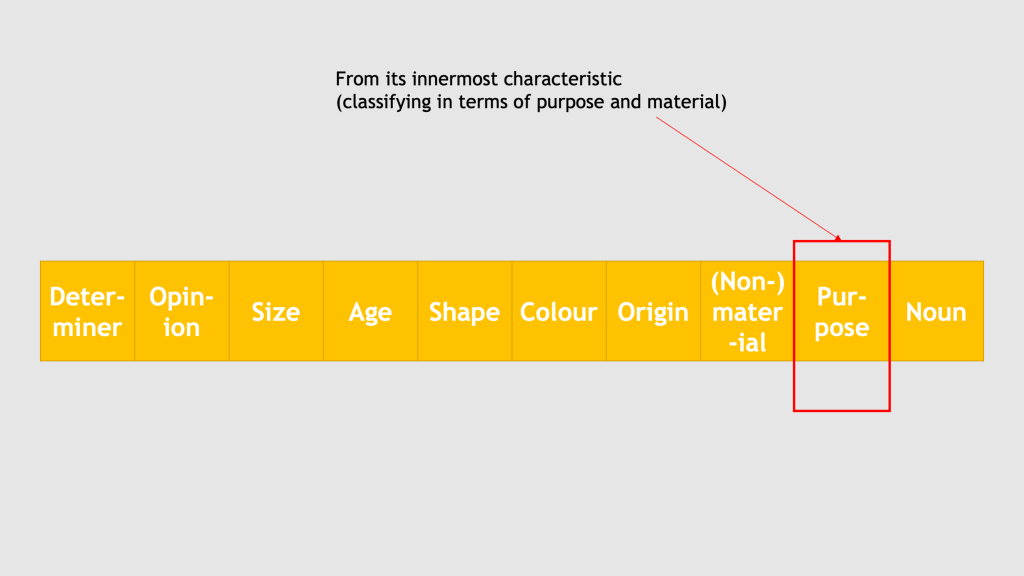
A teacher may tell you, “that’s the way it should be”; a linguist will tell you, “it can be explained.” Surely, nothing is definitive in the world of languages, but at least we can have explanations that we may agree. Here’s one: the closer the adjective is to the head noun, the more effective it is to classify the object/person based on its/his/her characteristics (from innermost to outermost).
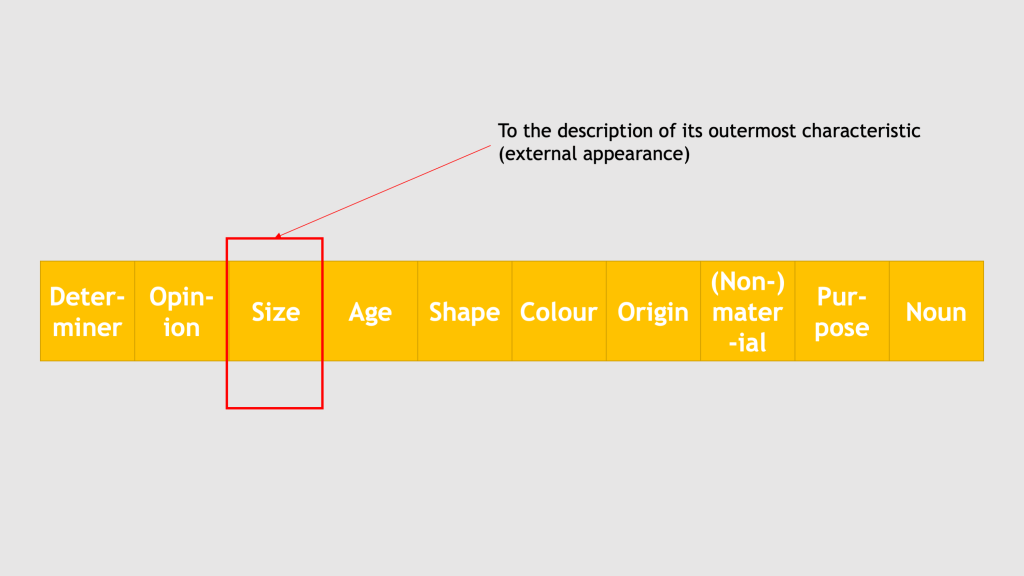
That means, storage would directly classify box in terms of its intrinsic function (storage box, lunch box, mail box), and then porcelain denotes the material, and so on. Then, the adjective moves from the box’s colour (on the object’s surface), shape, age to size (zooming out to more outward qualities). This seems to create an effect that each description moves towards to the observer, so that it is easier for him/her to identify.
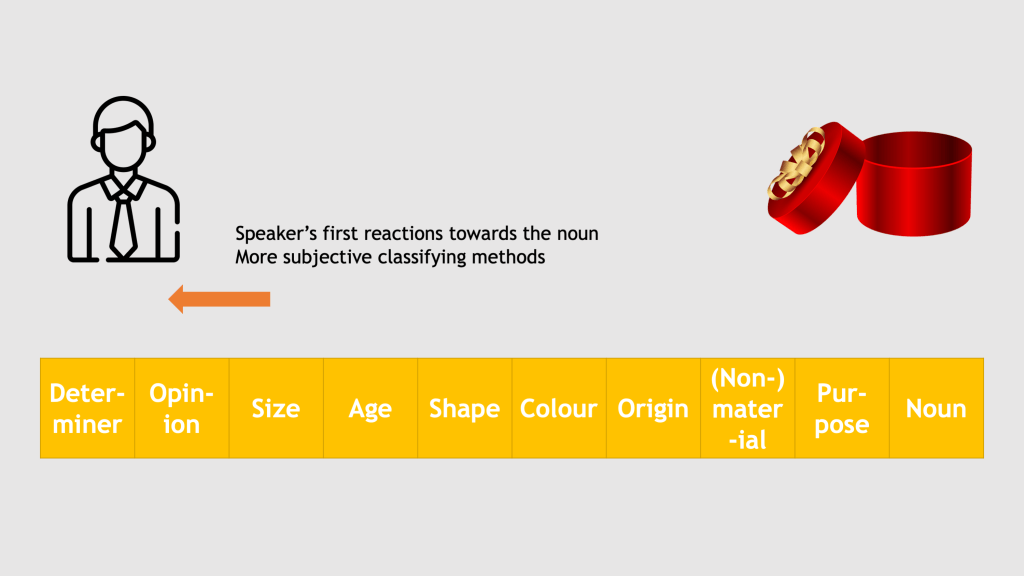
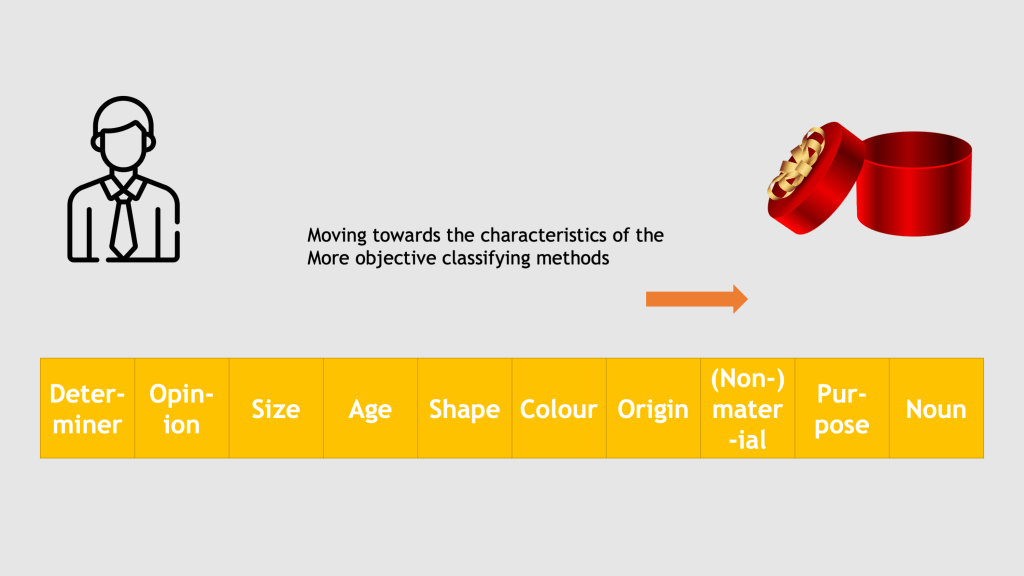
Conversely, the more distant the adjective is from the head noun, the closer the description is from the speaker’s/observer’s point of view. That’s the observer’s first reaction on the object/person (e.g. beautiful/ugly, nice/annoying, etc.) before moving towards the characteristics of the object/person.
There should be more systematic explanations out there. I’ll make my attempt to explain this more technically drawing on a semiotic/linguistic view, such as categorising the adjectives into the three parts, namely physical, cognitive and socio-semiotic realms in the near future. Let’s not complicate matters here.
I think many language teachers/linguists would agree that the grammatical pattern is systematic, but the usage is not. I will discuss elsewhere some interesting exceptions, using nouns as adjectives and using (or not) commas to separate adjectives.
At the end of the post, I include some external references for leisure reading — as if this post were oh so serious. See you next time. Ta-ta!
Reference websites:
The Odd Grammar Rule Most English Speakers Know But Are Rarely Taught https://www.mentalfloss.com/article/85863/odd-grammar-rule-most-english-speakers-know-are-rarely-taught
 Erik the Linguist
[…] No joke: one day after class, a student approached me and asked: what is a noun phrase? In secondary school, my teacher only taught us about single-word nouns. This was jaw-dropping — so no one told them the Subject in a sentence can be longer than one word?! At least before nouns you can add a lot of other grammatical components, especially adjectives. […]
LikeLike